
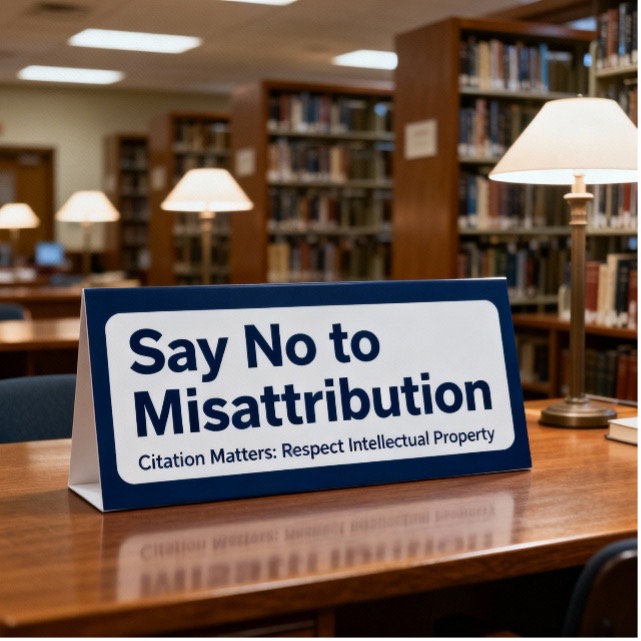
Avoiding Referencing Misattribution.
It’s important to clearly separate your own ideas from those of others when writing an assessment. Sometimes students merge their own ideas in a sentence with reference to another source, making it unclear when a cited author’s words end and your thoughts begin.
The following two examples demonstrate this point:
Pressure ulcers develop due to immobility (Jefferson & Kim, 2022)
In my view, frequent repositioning helps prevent ulcers (Jefferson & Kim, 2022).
What Is Misattribution?
Reference attribution means giving credit to the original source for any idea, quote, or information you use. When you cite properly, you meet ethical standards, show authority, and help readers check your sources. Statement 2 is an example of Reference Misattribution, this can mislead readers, undermine academic integrity and can be considered misconduct – even if unintentional.
Tips to avoid misattribution:
Remember: Own your ideas. Reference what others say, but take credit for your own thinking and original ideas. Take pride in your writing. Your thoughts are valuable, too.
|
|
Statement |
Notes |
| Correct |
The patient developed pressure ulcers due to prolonged immobility (Jefferson & Kim, 2022). |
Statement reports a finding directly supported by the source. |
|
Incorrect |
Based on my observations, more frequent repositioning decreased ulcer incidence (Jefferson & Kim, 2022). |
This is the student’s own conclusion, and is not found in the cited source. |
|
Correct |
In the presented case, pain management was tailored to individual response (Smith, 2020). |
Smith’s paper discusses individualised pain management. |
|
Incorrect |
As I observed during my placement, individual response dictates the pain management strategy (Smith, 2020). |
The statement is the student’s personal observation and is not stated in Smith’s paper. |
|
Correct |
The NMBA requires nurses to document wound assessment every shift (NMBA, 2016). |
Factual policy explicitly stated in NMBA standards. |
|
Incorrect |
During my case study, I ensured every wound assessment was documented each shift (NMBA, 2016). |
Statement is about the student’s action. The NMBA standard isn’t the direct origin of this claim. |
Avondale University acknowledges our Sovereign God as Creator and Provider of all things. We respectfully acknowledge the Awabakal and Darramuragal people as the traditional custodians of the lands on which we live, work, study and worship across our Lake Macquarie and Sydney campuses. We pay our respects to Elders past, present and emerging, and extend that respect to all First Nations People.
Avondale University is a member of the worldwide Seventh-day Adventist system of universities and colleges.
CRICOS Provider No.: 02731D. RTO: 91191. TEQSA: PRV12015. ABN: 53 108 186 401.
© Avondale University Ltd 2025